
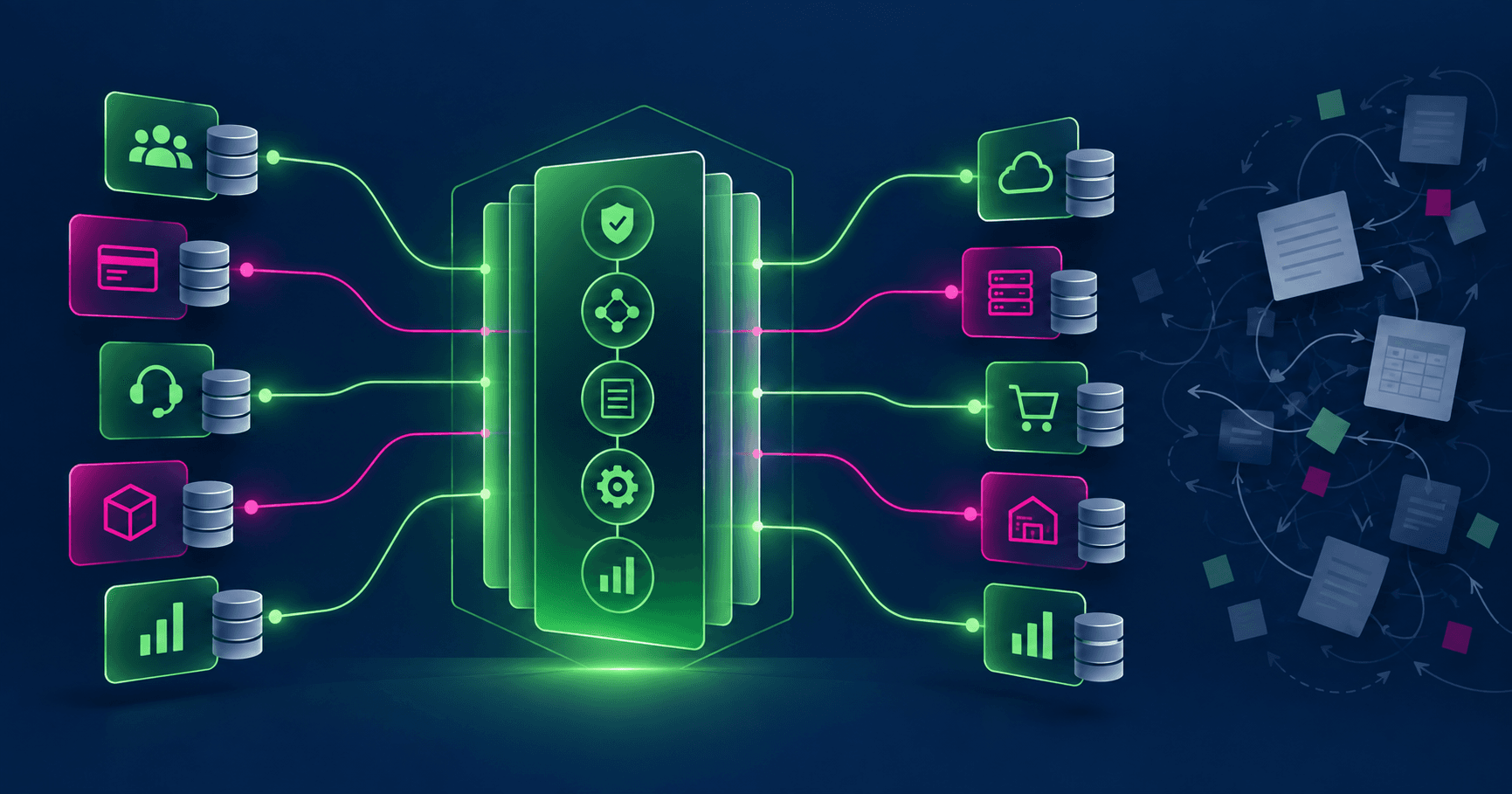
An agent that only sees one system can only do part of the job. Integration readiness comes down to one question with an expensive answer: when an agent needs to act beyond the CRM, can it actually do that?
What is integration readiness?
Integration readiness means the systems in a customer journey, CRM, billing, support, fulfillment, inventory, are connected through governed, observable interfaces an agent can safely act through. It’s the difference between an agent that answers “where’s my order?” and one that has to say it will check with the team.
Real work crosses systems
Think about what “handle this customer question” actually takes at your company. Someone touches the CRM, then billing, then maybe the support desk, moving between tabs without even thinking about it. Quote to invoice, order to fulfillment, renewal to provisioning. Every process that matters crosses a boundary somewhere.
Hand that job to an agent and every one of those boundaries becomes a wall. Can it check an order status? Issue a credit? Confirm inventory before promising a date? Or does every answer stop at the edge of the CRM, waiting on a person to bridge the gap the org never closed?
How did we get here?
Same way every company gets here. One urgent request at a time. A point to point connector for whatever broke last quarter. A CSV export somebody downloads every Tuesday. A Zapier chain nobody remembers building. Each fix made sense on its own, and the sum is a web of connections that works fine until something changes on one end and you find out the hard way that a person is updating the others by hand.
I’ve seen the access side of this play out directly. On more than one project, the credential that unlocked our connections into a client’s other systems lived wherever the last person who touched it happened to leave it, usually someone’s inbox or DM history. When that person moved on or the thread got buried, nobody could find it, and the only real fix was rotating every secret behind it and re-encrypting everything downstream. That’s a day or two of avoidable delay, purely because the access wasn’t governed anywhere.
This is normal. It’s also the third of the five readiness dimensions for a reason. It’s where agent ambitions most often run into org reality.
What does ready look like?
- Systems talk through a governed layer, not heroics. Connections are managed, monitored, and documented, not dependent on the one person who remembers how the duct tape is wound.
- Changes propagate reliably. When a record updates in one system, the others find out, observably, so a silent break gets caught before a customer does.
- Safe access is grantable. APIs and permissions exist so a system could act across your stack today, with boundaries, instead of “possible with custom work.”
Where to start
You don’t need to integrate everything before an agent shows up. You need to know which crossings actually matter, the two or three system boundaries your revenue flows across, and get those governed first.
We’ve been running something like Claudeforce since Feb 2026, and the pattern held for us too. The agent’s usefulness grew exactly as fast as the ground it could safely act on.
Integration is one of five dimensions in the Claudeforce Readiness Framework. The Claudeforce Readiness Quiz scores all five in a few minutes and shows you where to start.