
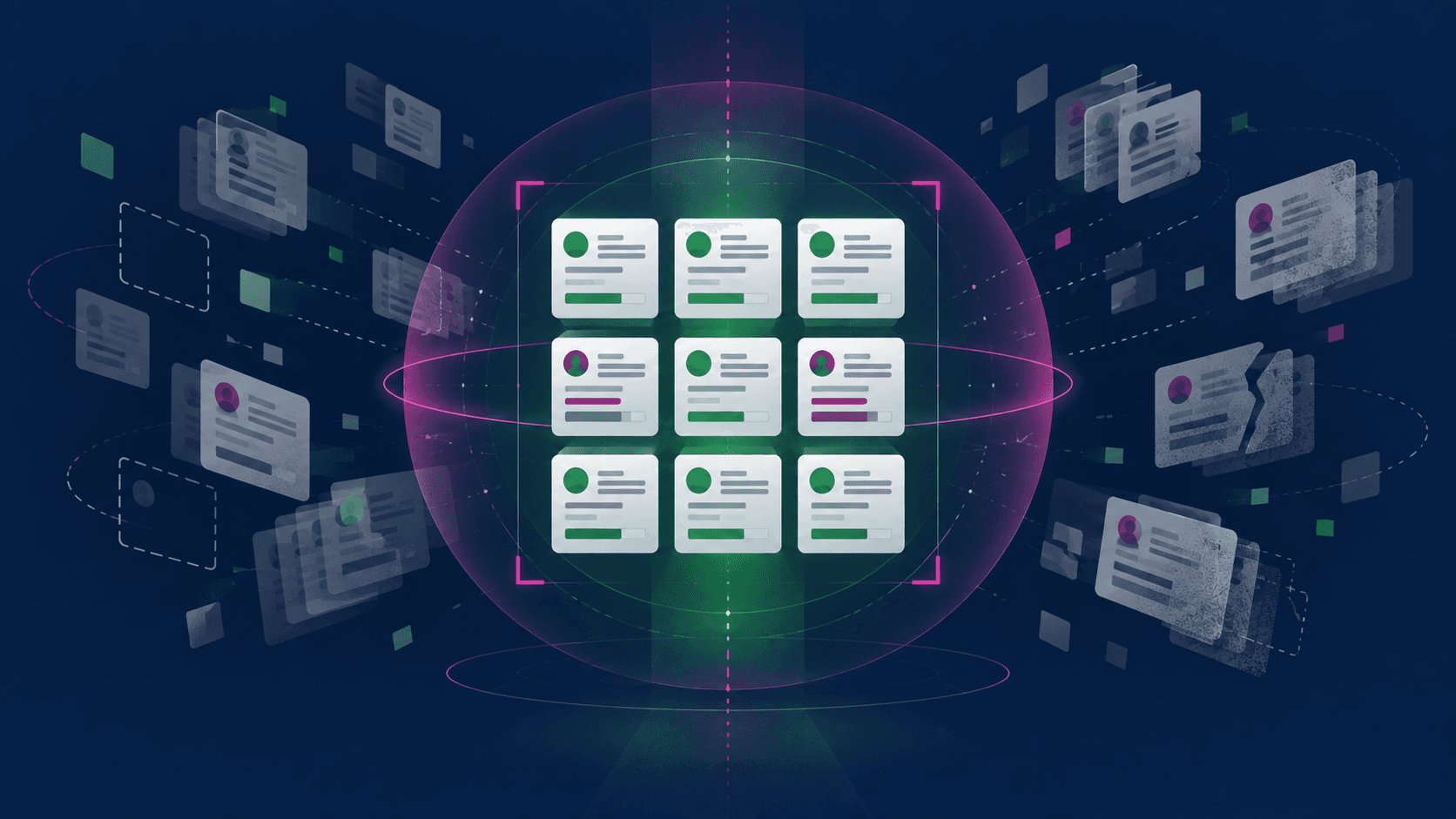
Salesforce has told the market that agents are coming to the CRM. Before one shows up in yours, I’d ask the question I almost never hear anyone ask: what is it going to find when it logs in?
What is data readiness?
Data readiness means the records in your CRM are accurate, current, and complete enough that an AI agent can act on them without a person interpreting first. In practice, that means the data is actively maintained, deduplicated, and treated as the source of truth, not as a report somebody cleans up the night before the board meeting.
Why humans survive bad data and agents don’t
People route around bad data so smoothly they stop noticing they’re doing it. Your best rep knows which records to trust, which opportunities are real, and which “open” deals actually died in March. None of that is written down. It lives in their head, and it quietly covers for everything the CRM gets wrong.
An agent has none of that. It takes your org at its word. Hand it duplicate accounts and it will work both copies. Hand it stale pipeline and it builds a forecast on deals that are already dead. Hand it empty fields and it fills the gaps with guesses or questions. An agent doesn’t fix a messy org. It scales whatever it finds.
How does data drift happen?
Nobody decides to have bad data. Companies grow, reps come and go, and record-keeping was always the tax nobody had time to pay. A few stale quarters later, the real numbers live in the forecast meeting and the CRM has quietly become the system of record in name only.
I think of this as organizational gravity. Every growing company fights it, and it isn’t specific to agents in the CRM. A copilot on your documents inherits your documents exactly as they are. The tool changes. The homework doesn’t.
What does ready actually look like?
Three things separate the orgs that are ready from the ones that are hoping:
- The source-of-truth test. The most accurate version of customer truth lives in the CRM. Not in a spreadsheet sitting next to it, not in your top rep’s inbox.
- Standards that are enforced, not aspirational. Required fields defined, followed, and audited. If reps fill in whatever they feel like, you have suggestions, not standards.
- Maintenance as a rhythm, not a rescue. Dedupe and cleanup happen on a schedule, not when somebody trips over a mess during quarter close.
None of this requires new software. It requires deciding that record quality is somebody’s actual job. That’s exactly why most orgs haven’t done it, and why the ones that have will get value from agents faster.
Where to start
Start by measuring instead of guessing. We’ve been running something like Claudeforce since Feb 2026, and the first hard lesson had nothing to do with the agent. It was about our own records, and how much of what we “knew” wasn’t written anywhere a system could see.
The one that stuck with me: an agent working our own queue read two empty fields on a work item, decided there was nothing to build, and kicked it back to a person, while the full spec sat in the body of the page where anyone scrolling would have seen it. The agent took the record at its word, which is exactly what we asked it to do. The fix had nothing to do with the agent. We put the details where a system could read them.
Data is one of five dimensions in the Claudeforce Readiness Framework, alongside knowledge, integration, governance, and workflow. The Claudeforce Readiness Quiz scores you on all five in a few minutes and shows you your weakest dimension, which is where I’d start.