
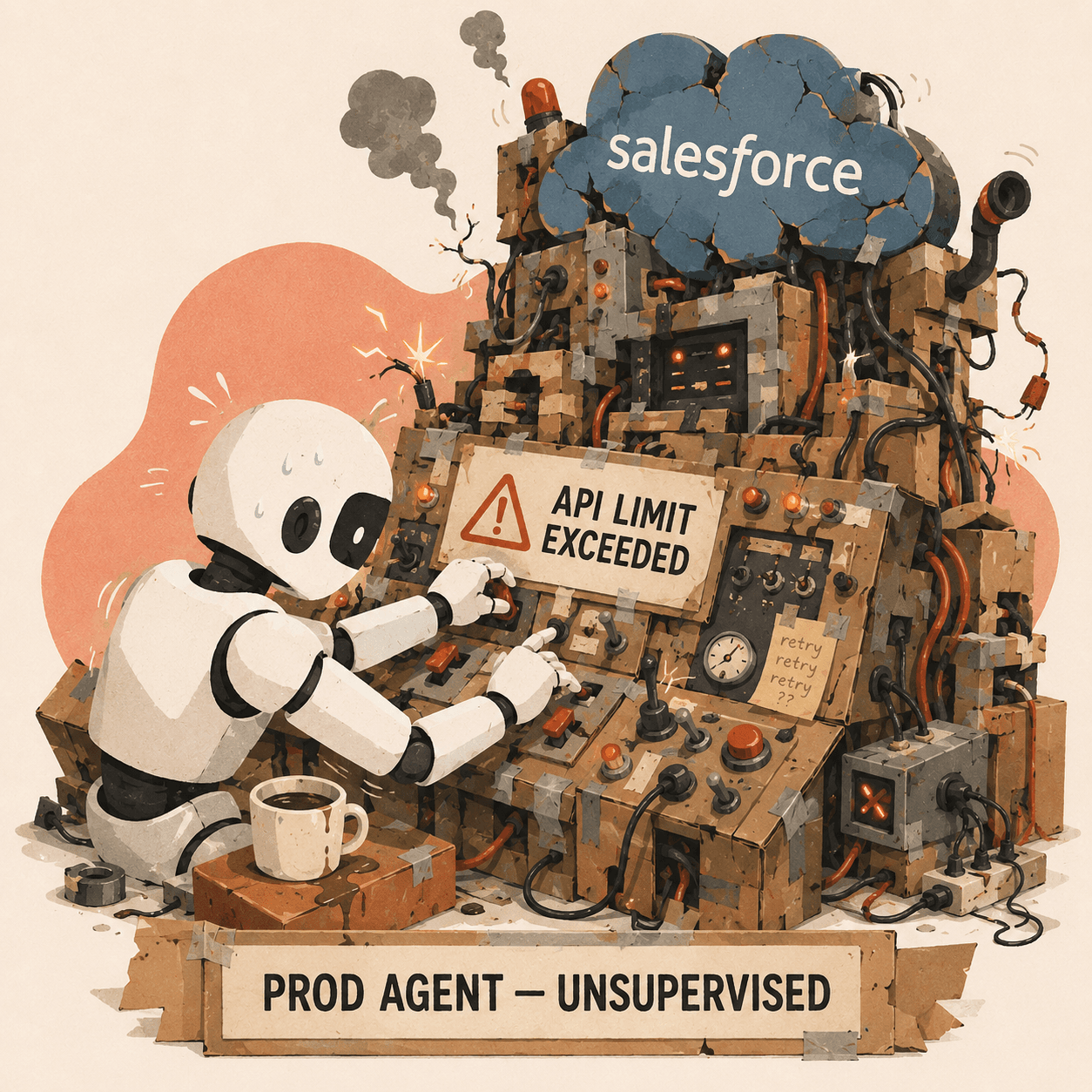
The rate isn’t the number that matters. The scope of work behind it is.
What does Salesforce consulting cost in 2026?
Most Salesforce consulting runs $150–$300+ an hour depending on the firm’s model, or a fixed project fee that typically lands in the tens of thousands for a focused engagement and climbs from there with org complexity. Boutique and offshore-heavy shops undercut on rate; large SIs charge a premium for brand and bench depth. Neither number tells you what you’ll actually pay, because hourly rate times estimated hours is a guess, not a quote — and guesses on Salesforce work are almost always low.
The honest number is a range, and the range is driven by variables that have nothing to do with who you hire’s billing rate. A tight, well-scoped project — clean up a broken automation, stand up a reporting layer, fix a Sales Cloud process that’s bleeding pipeline visibility — can land in 4–8 weeks at a fixed price. A “modernize our whole Salesforce instance” engagement with no defined milestones can run six figures and six months, and often does, regardless of who’s billing.
What drives the price up or down?
Rate is the smallest lever. Complexity is the big one. Four variables move the number more than any consultant’s hourly rate ever will:
- Org complexity. How many years of customization, how many admins have touched it, how many undocumented workflows are running the business without anyone realizing it.
- Data cleanup. Dirty, duplicated, or disconnected data turns a two-week integration task into a six-week forensic exercise. This is the single most underestimated cost driver in Salesforce work.
- Cloud count. Sales Cloud alone is a different job than Sales Cloud plus Service Cloud plus a MuleSoft integration layer tying it to your ERP.
- Agentforce and AI readiness. If you want agents acting on your data, your data model and permissions have to be sound first. That’s often the real project hiding under the AI request.
A firm that quotes you a number without asking about these four things isn’t scoping — it’s guessing, and you’ll pay for that guess later, usually mid-project when the change orders start.
Hourly vs. fixed-price vs. retainer — which is better?
Fixed-price wins for defined outcomes; retainers and hourly work only make sense for ongoing, undefined-scope support. Here’s the actual tradeoff:
Hourly is transparent in theory and unpredictable in practice. You’re billed for discovery, for rework, for the consultant’s learning curve on your org. There’s no ceiling unless someone imposes one.
Retainers make sense if you need a standing Salesforce admin function — someone fielding tickets, doing small enhancements, keeping the lights on. They’re the wrong model for a defined project because they remove the incentive to finish.
Fixed-price with fixed milestones is the model that protects the buyer. You know the outcome, the timeline, and the number before work starts. It forces the consultant to scope properly upfront instead of discovering scope as they bill hours against it. This is how we run every engagement — senior US-based architects, no offshore or nearshore markup games, and AI-accelerated delivery that compresses timelines without compressing quality. You get enterprise-grade architecture without paying enterprise-SI burn rates for the privilege.
Where the money is actually wasted
The most expensive Salesforce engagements aren’t the ones with the highest hourly rate — they’re the ones with no fixed milestones. Open-ended retainers and loosely scoped “let’s get in there and see what we find” projects are where budgets quietly triple. Nobody’s lying to you; nobody scoped the dirty data or the undocumented automation because nobody looked before the meter started running.
The fix isn’t negotiating a lower rate. It’s knowing what you’re actually dealing with before you scope anything. A quick, honest audit of your Salesforce instance — data quality, automation debt, integration gaps, Agentforce readiness — tells you where the real cost is hiding before a single hour gets billed. That’s what our Salesforce consulting engagements start with, and it’s why our projects come in on a fixed number instead of an expanding one.
FAQ
How much does a Salesforce consultant cost per hour?
Rates typically run $150–$300+ per hour depending on the firm’s model and seniority, but hourly rate is a poor predictor of total project cost — org complexity and data quality matter far more.
Is fixed-price or hourly better for Salesforce projects?
Fixed-price is better for defined-scope work because it caps cost and forces upfront scoping. Hourly and retainer models fit ongoing, undefined support — not a project with a clear finish line.
What makes Salesforce consulting more expensive than expected?
Dirty data, undocumented customization, and multi-cloud complexity — not the consultant’s rate — are what push costs beyond the original estimate.