
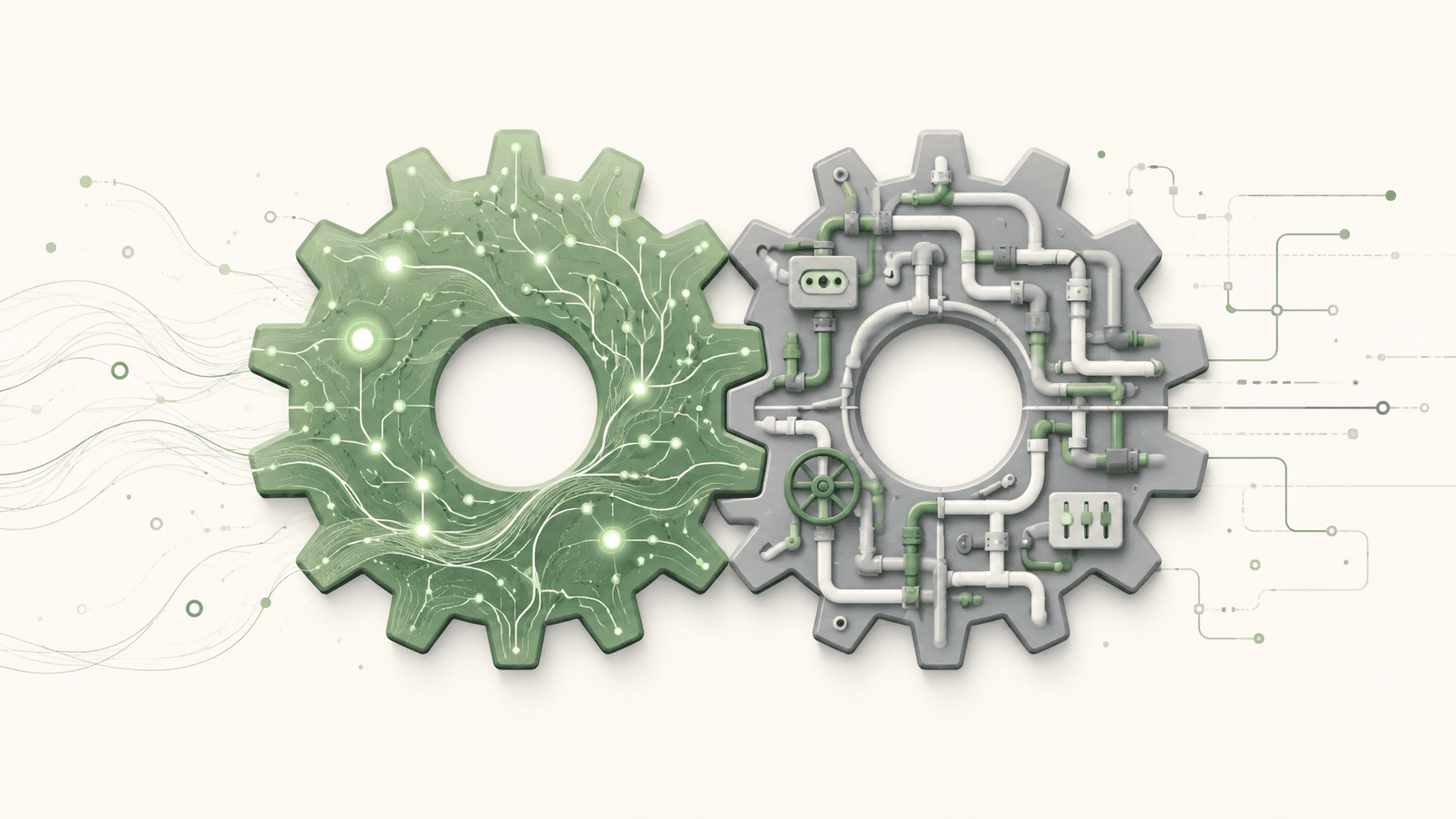
The thing standing between your AI investment and actual business outcomes isn’t the model — it’s the missing governed layer the AI has to work through.
What Is an AI Operating System?
An AI Operating System is the governed layer that sits between AI agents and your company’s real systems and data. It’s not a single app. It’s not a model. It’s the infrastructure — governed data, processes, permissions, and integrations — that turns a capable AI into one that produces outcomes inside your specific business.
Without it, you have a highly capable AI with nowhere to work. That’s the situation most mid-market companies are in right now, whether they realize it or not.
If you’ve spent the last 12 to 24 months standing up copilots, configuring agents, and watching vendors demo impressive things that never moved your P&L — the AI Operating System is the concept that explains why.
Why Your SaaS Stack Isn’t an AI Operating System
Your CRM, your ERP, your point tools — these are fixed substrates. They were built to hold data and run predefined workflows. They are very good at exactly that. Salesforce is a phenomenal system of record for pipeline and customer activity. MuleSoft moves data between those systems with precision and governance. These are not problems.
The problem is that bolting a chatbot or a copilot on top of a fixed substrate doesn’t give AI the governed access to act across your business. The agent is capable. It just has nowhere to work.
What you get when you skip the operating system layer:
- An AI that can summarize a Salesforce record but can’t act on it
- An agent that answers questions but can’t update downstream systems
- A copilot that writes emails but doesn’t know your deal stage, your contact history, or your pricing logic
- Demo-ready tools that die in production
Newer models don’t fix this. A frontier model running on top of a fragmented, ungoverned stack produces the same outcome the last generation did — a marginally better chatbot. The bottleneck was never the model. It was always the operating layer. (We made the longer version of this argument in The Road to AI-Native Runs Through Integration.)
What an AI Operating System Actually Looks Like
It has four components, and all four have to be present before the AI can do real work.
A governed context and data layer. The AI needs access to the right information — not a raw data dump, but structured, permissioned, contextual data. Who is this customer? What’s the current status of this deal? What does this integration contract say? Governed context is what separates an AI that gives you generic answers from one that gives you the right answer for your business, right now.
Integration that connects your systems. Your data doesn’t live in one place. It lives in Salesforce, in your ERP, in your billing system, in project management tools, in email. For an AI agent to act across your business — not just inside one app — those systems have to be connected at the API and data layer. This is where integration architecture becomes load-bearing infrastructure, not just a middleware concern.
A shared workspace where humans and agents work together. The AI can’t live entirely inside a black box. Teams need to see what it’s doing, verify its outputs, and maintain governance over decisions. A governed workspace — one where humans and agents share context, tasks, and records — is what makes AI-augmented work auditable and scalable rather than chaotic.
AI agents operating through the governed layer, not around it. When the first three components exist, an AI like Claude isn’t just answering questions — it’s doing work. Drafting and routing outputs. Surfacing the right context at the right moment. Running repeatable processes. Flagging exceptions for human review. The difference is that it’s doing all of this inside your governance model, not outside it.
The Question Most Companies Haven’t Asked
Most companies in 2026 have AI tools. They do not have an AI Operating System.
The distinction matters because AI tools produce activity. An AI Operating System produces outcomes — things that show up in your revenue, your delivery capacity, your team’s leverage.
The reason so many AI initiatives have stalled isn’t that the tools failed. It’s that the tools were dropped onto a stack that was never wired to let AI act. You can configure the world’s best agent, but if it can’t read your real customer data, update your real systems, and operate inside your real governance model, it’s a demo.
Companies that are actually moving their P&L with AI didn’t buy better tools. They built the operating layer first — or found a partner who knew how to build it on top of what they already had.
How Green Irony Builds It
We build AI Operating Systems on top of the systems you already run. Salesforce stays your system of record for pipeline and customer relationships. MuleSoft stays your integration backbone. We layer in Notion as the governed workspace where your teams and your AI agents share context and records. Claude operates as the AI layer, working through the governed context rather than around it — the same architecture we run our own company on.
The result is that your existing investments — the Salesforce implementation you spent years building, the MuleSoft architecture your team maintains — start producing AI outcomes instead of sitting underneath AI demos.
We’re not ripping anything out. We’re giving the AI a governed place to work inside what you already run.
That’s the whole model. And it’s the reason our clients start seeing P&L impact instead of just AI activity.
Find Out If You Have an AI Operating System
Most companies discover they don’t have one when they ask a direct question: can our AI agents actually act across our systems today, inside our governance model, with our real data?
If the honest answer is “not really” — or “sort of, in one system” — you don’t have an AI Operating System. You have AI tools on a fixed stack.
We run a short diagnostic to map exactly where the gap is: which systems are disconnected, where governed context is missing, and what it would take to give your AI somewhere real to work.
If you’re done watching AI demos and ready to build the operating layer, that’s where we start.