
The question keeps coming up the same way. A founder or CIO discovers what Claude can actually do — not the demo version, the real one, where it reads a contract, queries three internal systems, drafts an answer, and routes it for review — and the next thought is: do I still need the integration platform I just signed for?
The short answer is yes, and the reason matters.
Claude is extraordinary at reasoning. Pull in a customer’s order history, a vendor’s pricing sheet, and an open dispute, and it will produce a defensible recommendation faster and more cheaply than the workflow it’s replacing. That’s the part everyone sees in the first ten minutes.
The part most people don’t see is what Claude doesn’t do. It doesn’t natively maintain a system of record. It doesn’t enforce field-level governance across half a dozen back-office platforms. It doesn’t guarantee that the same customer record looks the same to the finance team, the field team, and the support team. It doesn’t generate the kind of audit trail an auditor expects to find when something breaks.
Those are the jobs of an integration platform. Not glamorous — but load-bearing.
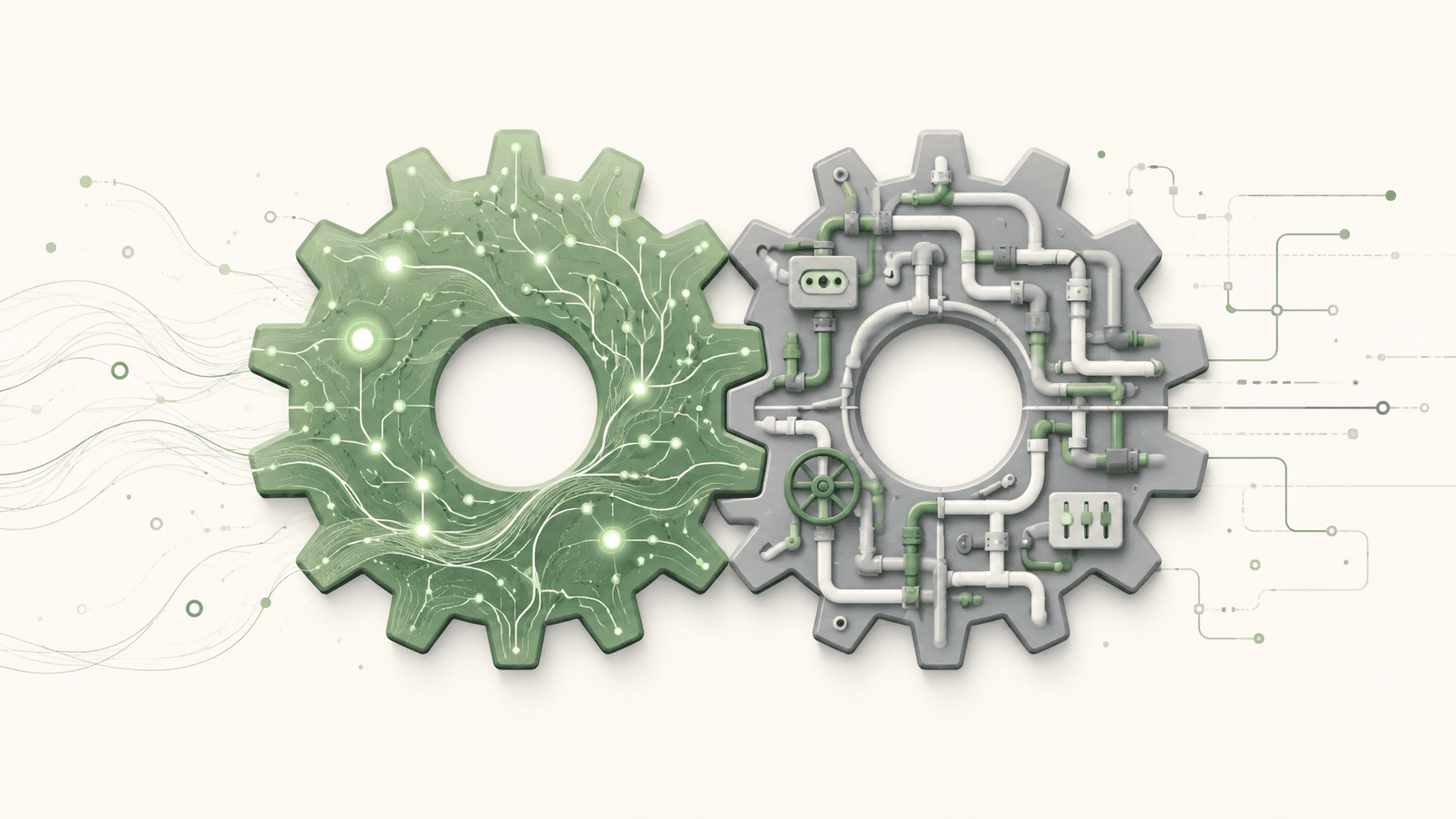
The right way to think about it is in two layers. Claude is the reasoning layer. The integration platform is the execution and governance layer. Claude decides what should happen; the integration platform makes sure it happens consistently, in the right system, with the right permissions, in a way the business can audit a year from now. Different jobs. Different layers. Both required.
The places this gets confused are usually the places where the existing integration footprint is small and brittle. If a company has three integrations, all of them point-to-point, and one of them is held together by a single engineer’s Python script — then yes, Claude can probably swallow the whole thing. The integration platform was never really doing the heavy lifting in the first place.
But the moment a business has real complexity — a real ERP, real customer master data, real partner integrations, real compliance obligations — the calculus inverts. Trying to have Claude reason through every transaction in real time, every time, against systems it has no native governance over, becomes the expensive and fragile path. Letting Claude reason about the hard cases, and letting the integration platform execute the high-volume, governed flows, becomes the durable path.
The partners and platforms in the middle of this debate — MuleSoft, Boomi, Workato, Celigo — are not being displaced. What is happening is more interesting. The boring middleware patterns of the last decade — batch syncs, scheduled jobs, point-to-point connectors — are getting eaten by AI reasoning, because AI reasoning is better at the messy, decision-heavy work those patterns were always a poor fit for. What’s left, and what’s getting more important, is the governed API layer: the controlled, auditable, permissioned surface that AI agents are going to call when they need to act on the business.
That’s what an integration platform like MuleSoft becomes in this world. Not the place where logic lives — the place where the boundary between what AI agents are allowed to do and what they’re not allowed to do gets enforced.
The businesses that are going to get the most leverage out of Claude over the next eighteen months are the ones that figure this out early. They invest in two things in parallel: a reasoning layer they let Claude own, and a governed API layer they let an integration platform own. They don’t try to make one tool do both jobs.
The ones that try to make Claude do everything will end up with brittle, ungoverned systems that work right up until they don’t. The ones that try to make the integration platform do everything will keep paying enterprise rates for the kind of decision work AI now does in seconds.
The two-layer model is the answer. Claude reasons. The integration platform executes and governs. They’re complementary, not substitutive. You don’t pick one. You need both.
Aaron Godby is the founder of Green Irony, which builds the integration substrate underneath companies running operationally on Claude.