
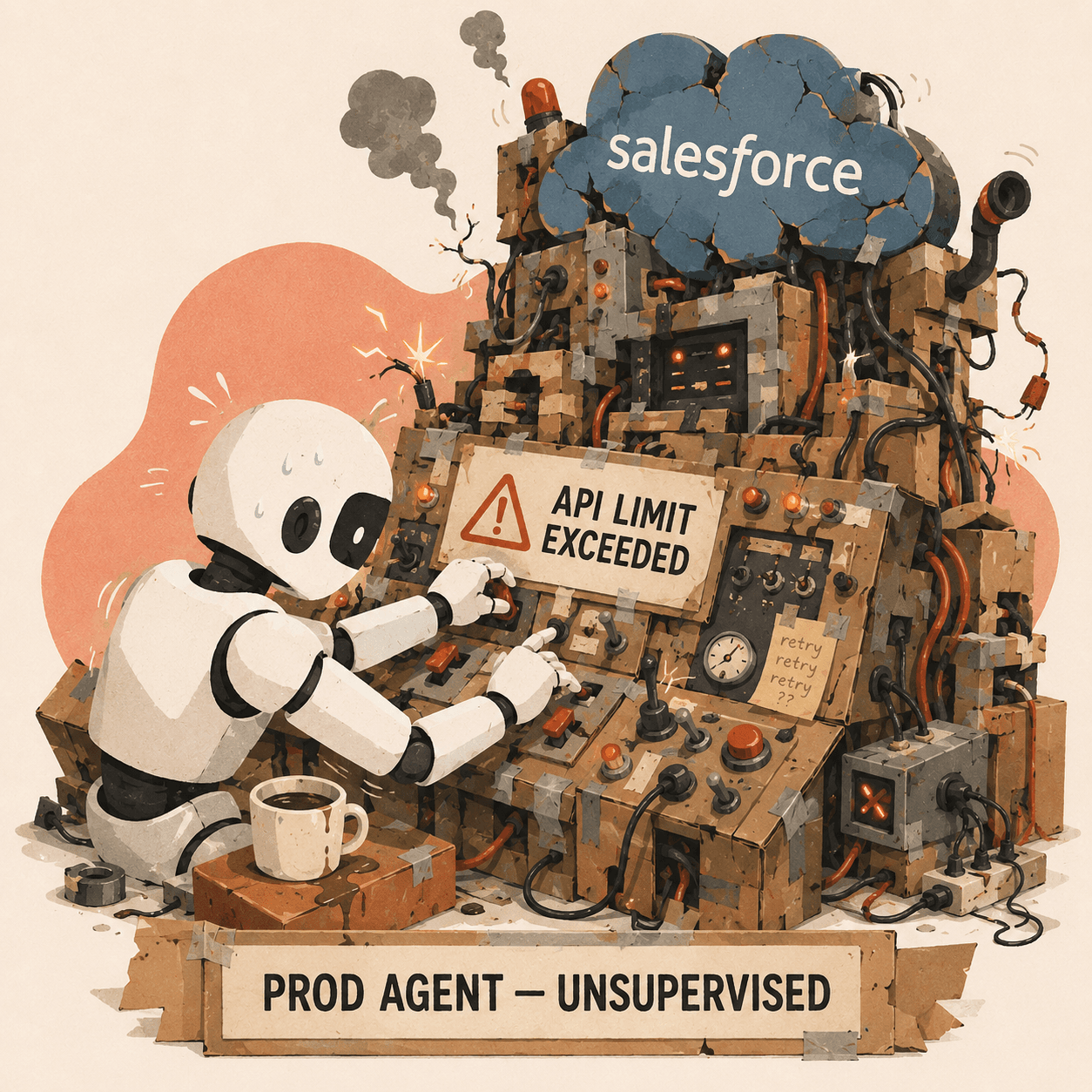
The governed API layer is what turns an AI agent from a chatbot into something that can safely act.
Can Claude Connect to MuleSoft?
Yes, and the mechanism is simpler than most teams expect. Claude connects to MuleSoft the same way any other agent connects to any other system: through tools. You expose a set of MuleSoft-managed APIs as callable tools, Claude decides when to call them based on the conversation or task, and MuleSoft’s API layer handles the actual execution against your backend systems. Claude never talks directly to SAP, your order management system, or your data warehouse. It talks to a governed API that MuleSoft built and controls, and that API talks to the backend.
This is not a new integration pattern. It’s the same API-led connectivity model MuleSoft has run for a decade, applied to a new class of caller. The caller used to be a mobile app or a partner system. Now it’s an AI agent.
How Does It Actually Work?
An AI agent operates on a simple loop: it reasons about a task, decides it needs to take an action, calls a tool, and reads the result back into its context to decide the next step. MuleSoft’s job in that loop is to be the tool. Your experience or process API becomes the interface the agent calls. Your system API layer still does what it always did: enforce data contracts, handle transformation, manage security policy, log every transaction.
That last part is the whole point. An agent that can only chat is low risk and low value. An agent that can update a customer record, issue a refund, or kick off a fulfillment order is high value and needs guardrails. MuleSoft is what makes an agent’s action safe, auditable, and reversible. Every call the agent makes runs through the same policies, rate limits, and audit trail your human-built integrations already run through. If something goes wrong, you have a system-of-record log of exactly what the agent did and when, not a black box.
What Does This Look Like in Practice?
Take a concrete case: a support workflow where Claude is asked to check order status and process a return. Claude doesn’t get raw database credentials. It gets a tool definition for “get order status” and “initiate return,” both backed by MuleSoft experience APIs that sit in front of the order management system and the returns process. When a customer asks about a late order, Claude calls the order-status tool, MuleSoft’s API validates the request, pulls the record through the existing system API layer, and returns a clean response. If the customer wants a return, Claude calls the return-initiation tool. MuleSoft enforces the business rules (return window, eligibility, approval thresholds) before anything touches the backend. Claude never bypasses those rules because it never has the ability to. It only has the tool MuleSoft gave it.
Run that same pattern across five, ten, or fifty backend systems and you start to see why the integration layer matters more, not less, as agents get more capable. Without it, every new agent needs its own bespoke, unaudited path into each system. With it, every agent, human tool, and future AI product reuses the same governed set of APIs.
When Do You Actually Need MuleSoft in the Loop?
You need it the moment an agent’s action has a consequence outside the conversation: writing data, triggering a process, moving money, touching a system of record. Anything with a side effect deserves a governed path, full stop. You also need it when more than one caller (a human app, a partner, an agent) needs the same underlying data or process, because that’s exactly the reuse problem API-led connectivity was built to solve in the first place.
When You Don’t Need MuleSoft in the Loop
Be honest about the other side, because it makes the whole argument stronger. If Claude is summarizing a document, drafting copy, or reasoning over information you’ve already handed it, there’s no integration layer required. Read-only lookups against a single, already-exposed API might not need a new integration effort either. Not every AI use case is an integration use case. The mistake we see is teams building governance for chat and skipping it for action. It should be the reverse. Chat is low stakes. Action is where the integration layer earns its keep.
Where This Leaves You
Claude and MuleSoft aren’t competing for the same job. Claude is the reasoning and interface layer. MuleSoft is the governed connectivity layer that lets that reasoning turn into safe, logged, reversible action. We run our own operation this way: agents that need to act go through governed APIs, not direct system access, because that’s the only version of “AI agent with write access” any of us should be comfortable shipping.
If you’re running MuleSoft today and you’re being asked to make AI agents actually do things instead of just answer questions, this is the wiring diagram. If you want a second set of eyes on your specific API layer and where the agent boundary should sit, talk to one of our architects. That’s a conversation, not a sales pitch.