
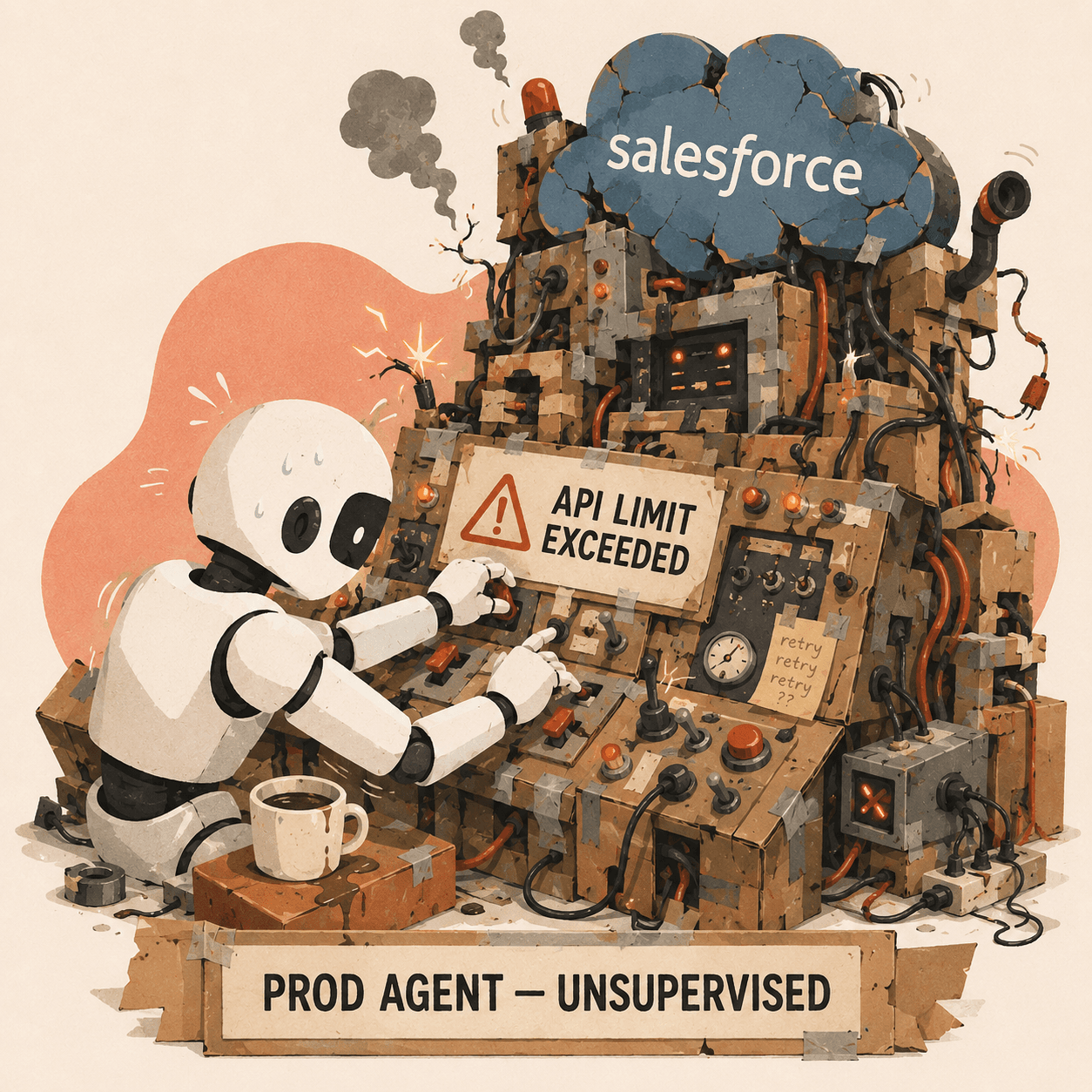
Agent sprawl is what happens when every team ships its own AI agent and none of them answer to the same rules.
Agent sprawl is the uncontrolled proliferation of AI agents across an enterprise — built by different teams, embedded in different SaaS tools, each one calling backend systems directly with its own credentials, its own logic, and no shared oversight. It is the same pattern that produced point-to-point integration spaghetti and shadow IT a decade ago, except this time the endpoints can act on their own and often have write access to production systems. A sales team stands up an agent to update opportunities. A support team plugs one into the ticketing system. A vendor ships an agent baked into their platform that reaches into your CRM without anyone in IT signing off. None of them were designed together. All of them now touch the same systems of record.
If that sounds familiar, it should. Green Irony has spent years cleaning up the aftermath of ungoverned integration sprawl — the tangle of scripts and point-to-point connections that accumulates when every team solves its own problem without a shared layer underneath. Agentic AI is recreating that problem at a faster clip, because agents don’t just move data, they take action, and they multiply faster than any integration project ever did.
Why agent sprawl is dangerous
The risk isn’t that agents exist. It’s that they exist without governance. A handful of specific failure modes show up consistently:
- No unified identity or authority. If every agent authenticates differently and carries its own permissions, you can’t answer a basic question: what is this agent actually allowed to do, and on whose behalf?
- No observability across agents. When agents call systems directly, there’s no single place to see what ran, what changed, or what failed. You find out about a problem when a customer complains, not when it happens.
- Duplicated and conflicting actions. Two agents updating the same record from two different assumptions is worse than no automation at all — it erodes trust in the data faster than a manual process would.
- No audit trail. Compliance and security teams need to reconstruct who — or what — did what, when. Direct agent-to-API calls rarely leave that trail in a usable form.
- Brittle, direct-to-API connections. Every agent wired straight to a backend system is another integration that breaks silently when that system changes a field, a schema, or an auth method.
None of this is a reason to slow down on agentic AI. It’s a reason to put a layer underneath it before the count of ungoverned agents goes from three to thirty.
The governing pattern: agents call a governed layer, not raw APIs
The fix is not new, even if the framing is. It’s the same discipline that API-led connectivity has applied to integration for years: don’t let every consumer talk directly to every system. Put a managed layer in between. Agents should call governed endpoints — not raw, unmanaged APIs sitting on top of your CRM, ERP, or data warehouse.
That governed layer is what gives you the things direct API calls can’t: consistent identity and access control for every agent regardless of who built it, rate limiting so one runaway agent can’t take down a shared system, standardized error handling, centralized observability and logging, and reusable actions that multiple agents can call instead of each team rebuilding the same connection. It’s the difference between thirty agents each improvising their own path into Salesforce and thirty agents calling the same well-defined, monitored, permissioned set of actions.
Salesforce has started giving this pattern a name of its own: Agent Fabric. As Salesforce describes it, Agent Fabric is the connective layer that lets agents — Agentforce or otherwise — discover and invoke governed actions across systems, with MuleSoft positioned as the substrate those actions actually traverse. Read plainly, it’s Salesforce’s articulation of the same principle integration teams have practiced for a decade: govern the path between the caller and the system of record, don’t let the caller reach in directly. We’ve written about what this looks like in practice for headless Salesforce architectures built for AI agents, and about the safe pattern for connecting agents to a Salesforce CRM without handing them the keys to the whole org.
What “governed agents” looks like in practice
You don’t need a grand unified platform to start. You need a short list of things to be true before an agent goes near a production system:
- Every agent authenticates through a single, auditable identity scheme — no agent-specific service accounts created ad hoc.
- Agents call named, versioned actions (get customer, update case, create order) instead of raw database or API calls.
- Every action an agent takes is logged in one place, not scattered across whatever tool built the agent.
- Rate limits and error handling live in the governed layer, not in each agent’s own code.
- New agents reuse existing governed actions by default; building a new direct connection is the exception that requires sign-off, not the default path.
- Someone owns the layer — its uptime, its permission model, its change management — the same way someone owns your integration platform today.
If you can’t check most of these boxes today, you already have agent sprawl. You may just not have counted the agents yet.
This is an architecture problem, not a shopping list
It’s tempting to treat this as something you solve by buying the right platform. You don’t. Agent Fabric, MuleSoft, Agentforce — these are the pieces, not the plan. Someone still has to decide which actions get exposed, how identity flows through the stack, what the audit trail needs to capture for your compliance posture, and how legacy systems that were never built with agents in mind get folded into the governed layer without a multi-year rip-and-replace. That’s design and architecture work. It’s the same work integration teams have always done, applied to a new class of caller that happens to be autonomous.
Enterprises that treat this as a licensing decision end up with a governed layer in name only — a product installed, no design behind it, and the same sprawl one layer down.
Where Green Irony fits
Green Irony has been a MuleSoft partner since 2018 and a Salesforce partner since 2016. We’ve spent that time building the governed integration layer underneath enterprises that didn’t have one, long before “agent” was part of the vocabulary. The pattern hasn’t changed — call governed endpoints, not raw systems — the callers have just gotten more autonomous. Our delivery is senior, US-based, and AI-accelerated, which means we can design and stand up that governed layer faster than a traditional systems-integrator bench, without cutting corners on the architecture decisions that determine whether it holds up under real agent traffic.
If your teams are already shipping agents faster than anyone can govern them, that’s worth a conversation before the count gets to thirty. You don’t need to rip out what you run today — you need a governed layer on top of it.
Frequently asked questions
What is agent sprawl?
Agent sprawl is the uncontrolled proliferation of AI agents across an enterprise — built by different teams and vendors, each calling backend systems directly, without shared identity, oversight, or an audit trail.
Why is agent sprawl a problem?
Ungoverned agents create duplicated or conflicting actions, no unified way to see what agents did or why, security and compliance exposure from inconsistent access controls, and brittle direct connections to core systems that break when those systems change.
How do you govern AI agents?
By putting a managed integration layer between agents and systems of record, so agents call governed, monitored, permissioned actions instead of raw APIs. This gives you consistent identity, rate limiting, error handling, observability, and reusable actions across every agent, regardless of who built it.
What is Agent Fabric?
Agent Fabric is Salesforce’s term for the connective layer that lets agents discover and invoke governed actions across systems, with MuleSoft serving as the substrate those actions travel through. It’s Salesforce’s framing of the broader governed-integration pattern.
Does MuleSoft replace my agents?
No. MuleSoft doesn’t replace your agents or your systems of record — it governs how agents reach your data and actions, giving you one consistent, auditable path instead of dozens of direct, ungoverned connections.