
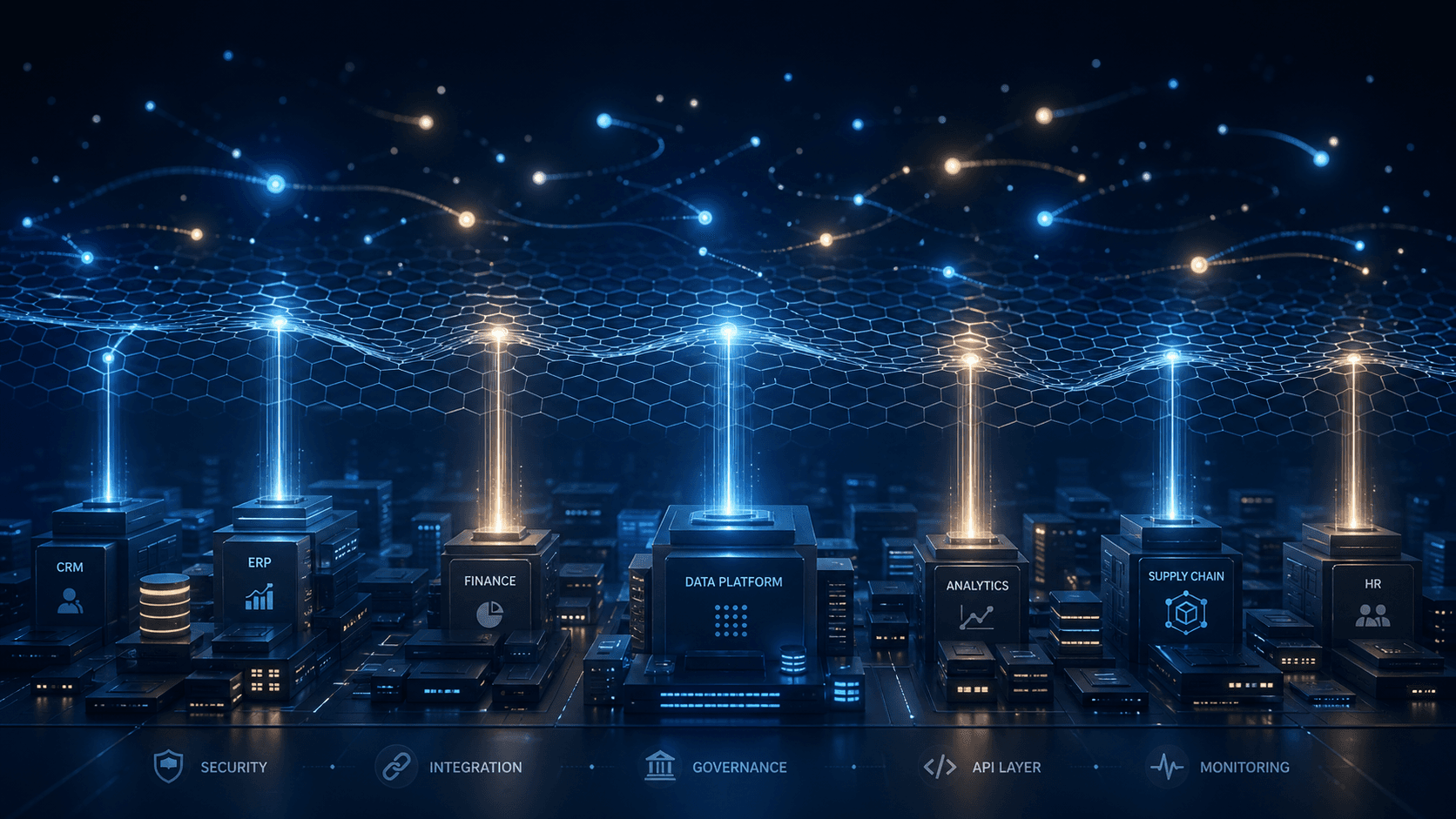
API-led connectivity is the architectural discipline that keeps integration from turning into a liability every time a system changes — and it’s the reason AI agents can call your systems safely instead of inheriting years of technical debt.
API-led connectivity is an integration approach — popularized by MuleSoft — that organizes APIs into three purpose-built layers instead of building one-off point-to-point connections between systems. Each layer has a job: System APIs expose the data and functions of a backend system, Process APIs orchestrate that data into business logic, and Experience APIs shape the output for a specific consumer, like a mobile app, a portal, or an AI agent. The layering matters because it lets you change or replace any one system without breaking everything downstream of it.
The three layers, plainly
Most of the confusion around API-led connectivity clears up once you separate what each layer is actually for.
- System APIs wrap a source system — Salesforce, an ERP, a data warehouse, a legacy database — and expose its data through a stable, standardized interface. Nobody outside this layer talks to the raw system directly.
- Process APIs sit above the system layer and orchestrate business logic across multiple systems. A “create customer” process API might touch three or four System APIs in sequence, applying validation and business rules along the way, without any caller needing to know how many systems are actually involved.
- Experience APIs tailor that orchestrated data for a specific consumer. A web app, a mobile app, a partner portal, and an AI agent each need the same underlying data shaped differently — Experience APIs handle that shaping without duplicating logic further down the stack.
The point of the layering isn’t elegance for its own sake. It’s reuse and isolation. When a Process API needs data from a system, it calls a System API rather than reimplementing that connection. When the underlying system gets replaced — a new ERP, a new instance of a Salesforce org after an acquisition — only the System API layer needs to change. The Process and Experience layers, and everything built on them, keep working. That’s the entire value proposition in one sentence: change one system without breaking the others.
Why it beats point-to-point integration
The alternative to API-led connectivity is point-to-point integration: system A talks directly to system B, which talks directly to system C, and so on, with custom code or middleware wiring stitched in wherever two systems need to exchange data. Point-to-point is fast to build the first time. It is the reason most mid-market IT organizations eventually end up with what practitioners call a “big ball of mud” — a tangle of direct connections where nobody can say with confidence what will break if they touch any single piece.
Point-to-point integration doesn’t fail all at once. It fails by getting slower every year. Every new system adds connections to every existing system it needs to talk to, so complexity grows combinatorially, not linearly. Testing a change means testing every downstream dependency, because there’s no abstraction layer absorbing the blast radius. Eventually, teams get scared to touch the integration layer at all, and that fear becomes a tax on every future project. API-led connectivity exists specifically to break that curve: reusable layers mean the tenth integration is cheaper to build than the third, not more expensive.
Why it matters more in the agent era, not less
There’s a temptation to treat integration architecture as a solved, boring problem now that the interesting work has moved to AI agents. That’s backwards. Agents don’t reduce the importance of a clean integration layer — they raise the stakes on it.
An AI agent that needs to look up an account, check an order status, or update a record doesn’t read your database schema. It calls an API. If that API is really a fragile point-to-point connection wearing an API mask, the agent inherits every bit of that fragility — undocumented failure modes, inconsistent error responses, no versioning, no way to trace what happened when something goes wrong. You’ve just handed a probabilistic system a brittle, ungoverned integration path and asked it to act autonomously on top of it. That’s how small integration problems become customer-facing incidents fast, exactly the concern that comes up whenever we talk through agents calling Salesforce directly instead of going through a browser session.
API-led connectivity gives agents what they actually need: a stable, versioned, observable, governed surface to call. The System and Process layers don’t care whether the caller is a human-built app, a partner integration, or an autonomous agent — they just need well-defined contracts. That consistency is what lets you trust an agent to act on your systems. The model isn’t the constraint anymore in most of these projects. The integration layer is.
What good looks like
Not every implementation that calls itself “API-led” is actually delivering the benefits. A few things separate the ones that hold up over time from the ones that quietly become the next big ball of mud:
- Versioned APIs — breaking changes ship as a new version, not a silent overwrite of the old contract.
- Explicit error handling — consistent, structured error responses at every layer, not a mix of stack traces, timeouts, and silent failures.
- Observability and correlation IDs — the ability to trace a single request across System, Process, and Experience layers when something goes wrong, especially critical once agents are initiating calls without a human watching in real time.
- Reuse via a catalog — APIs are discoverable and documented so the next project reuses a System API instead of building a new direct connection around it.
- Governance — clear ownership, access controls, and standards enforced consistently, not left to whichever team built the API first.
None of this is exotic. It’s the same discipline that made Salesforce MuleSoft integration work well for a decade of pre-AI projects. The difference now is that the cost of skipping it shows up faster, because agents surface integration gaps in production instead of in a QA cycle.
Green Irony has been a MuleSoft partner since 2018 and a Salesforce partner since 2016. We design integration layers meant to survive years of platform change, not just the current project — senior US-based architects, AI-accelerated delivery, and no shortcuts on the governance work that keeps an API layer trustworthy five years in. If you’re evaluating whether your current integration setup can support agent-driven workflows, or you’re starting from a point-to-point mess and need a path out, our MuleSoft practice is a good place to start that conversation.
Frequently asked questions
What is API-led connectivity?
API-led connectivity is an integration approach that organizes APIs into three reusable layers — System, Process, and Experience — instead of connecting systems directly to each other. It’s designed to make integrations reusable and to let one system change without breaking the others that depend on it.
What are the three layers of API-led connectivity?
System APIs wrap a source system and expose its data through a stable interface. Process APIs orchestrate business logic across multiple System APIs. Experience APIs shape that data for a specific consumer, such as a mobile app, portal, or AI agent.
How is API-led connectivity different from point-to-point integration?
Point-to-point integration connects systems directly to each other, so complexity grows with every new system added and small changes risk breaking unrelated connections. API-led connectivity isolates that risk in reusable layers, so a change to one system only requires updating its System API, not every downstream integration.
Why does API-led connectivity matter for AI agents?
AI agents interact with business systems through APIs, not through screens or databases directly. If those APIs are ungoverned or fragile, agents inherit that fragility and can act unpredictably. API-led connectivity gives agents stable, versioned, observable endpoints to call, which is what makes autonomous or semi-autonomous agent workflows trustworthy in production.
Does API-led connectivity replace an API gateway?
No. An API gateway is infrastructure that manages traffic, security, and access to APIs. API-led connectivity is an architectural pattern for how those APIs are organized and layered in the first place. Most API-led implementations run through a gateway; the gateway doesn’t decide the layering, it enforces policy on top of it.