
Choosing a Salesforce implementation partner used to be about who could configure the fastest. In 2026, it’s about who can make your org safe for AI to act on.
What does a Salesforce implementation partner actually do?
A Salesforce implementation partner designs, builds, and maintains your Salesforce environment — architecture, data model, integrations, automation, and user adoption — so the platform actually runs your business instead of just holding your data. That sounds simple. It isn’t.
Most companies don’t fail at Salesforce because they picked the wrong edition or missed a feature. They fail because nobody owned the architecture. Fields get bolted on. Integrations get duct-taped together with point-to-point API calls. Automation piles up until nobody can explain why a record updates the way it does. Three years later you have a system that technically works and functionally terrifies everyone who touches it.
A good implementation partner prevents that outcome from day one. They bring architects who’ve seen how orgs decay over time, not just consultants who know where the buttons are. The deliverable isn’t a working demo — it’s a system that’s still coherent after five more integrations, ten more automations, and two more acquisitions.
How do you evaluate a Salesforce implementation partner?
You evaluate a Salesforce implementation partner the same way you’d evaluate a surgeon, not a contractor: on judgment under real conditions, not on a polished pitch. Here’s what actually separates the field.
Look at tenure, not logos. Anyone can put a client logo on a slide. Ask how long the partner has held Salesforce Consulting Partner status, and ask what that partnership tier actually required them to prove. Green Irony has been a Salesforce Consulting Partner since 2016 — that’s a decade of renewals, not a badge from a weekend certification.
Ask who’s actually doing the work. Not “who’s on the proposal” — who shows up to the build. Junior teams staffed against senior sales pitches is the single most common bait-and-switch in this industry. Ask for the named architect and ask where they’re based.
Ask about integration philosophy, not just Salesforce. Salesforce rarely lives alone. If the partner can’t speak fluently about MuleSoft, middleware, or how your ERP and support stack talk to Salesforce, they’re solving a fraction of your actual problem. Integration architecture is where most long-term technical debt gets created — or avoided.
Ask what happens after go-live. A partner who disappears after launch isn’t a partner, they’re a vendor. Fixed-price engagements with a real transition plan tell you more about a firm’s confidence in its own work than any case study will.
Ask them to audit your current setup, free, before you sign anything. If a partner won’t tell you what’s actually wrong with your Salesforce org before you’re a paying customer, they don’t know — or they’re saving the bad news for the invoice. Green Irony runs a free SaaS Audit for exactly this reason: you should see the diagnosis before you buy the treatment.
What are the red flags when choosing a Salesforce partner?
The clearest red flag is a partner who talks entirely about features and never about your data model, your architecture, or your governance. If the conversation stays at the level of “we’ll build you a flow for that,” you’re hiring someone to configure clicks, not to think about your business.
Other signals worth watching for:
- Vague staffing answers. If they won’t commit in writing to who’s on the build, assume it’s not who pitched you.
- Time-and-materials with no ceiling. Open-ended billing on a project with a defined scope is a partner hedging against their own estimate, at your expense.
- No point of view on AI. If a partner has nothing to say about Agentforce, AI agents, or how your data needs to change to support them, they’re planning for a version of Salesforce that’s already behind.
- A demo that never touches your data. Generic demos are easy. A partner who insists on looking at your actual org, your actual fields, your actual mess, before quoting you — that’s the one paying attention.
- Pressure to sign fast. A real architecture conversation takes more than one call. If they’re rushing you past discovery, they’re rushing past the part where they’d find the hard problems.
Onshore vs. offshore — does it matter?
Yes, and not for the reason most people assume. It’s not a patriotism argument — it’s an accountability and architecture-quality argument. Complex Salesforce and integration work requires judgment calls in real time: when a data model decision made in week two will cause a problem in month eight, you need an architect who can see that coming and push back, not a resource executing a ticket.
Offshore and nearshore delivery models are built around labor arbitrage — the pitch is “same work, lower cost,” and the way that math works is more junior people, more hours, less senior judgment per dollar. Green Irony’s cost edge comes from somewhere else entirely: an AI-native delivery model where senior US-based architects use AI-accelerated tooling to move at a pace that used to require a much bigger, much more junior team. Same senior judgment, fewer wasted cycles. That’s a fundamentally different way to get to a competitive price than cutting seniority.
Every engagement at Green Irony is staffed with senior US-based architects — no offshore, no nearshore, full stop. That’s not a nice-to-have. On a system this central to your revenue, the architect making the decisions should be someone who can get on a call at 9am your time and has enough experience to know which shortcuts are safe.
How does agent-readiness change the 2026 decision?
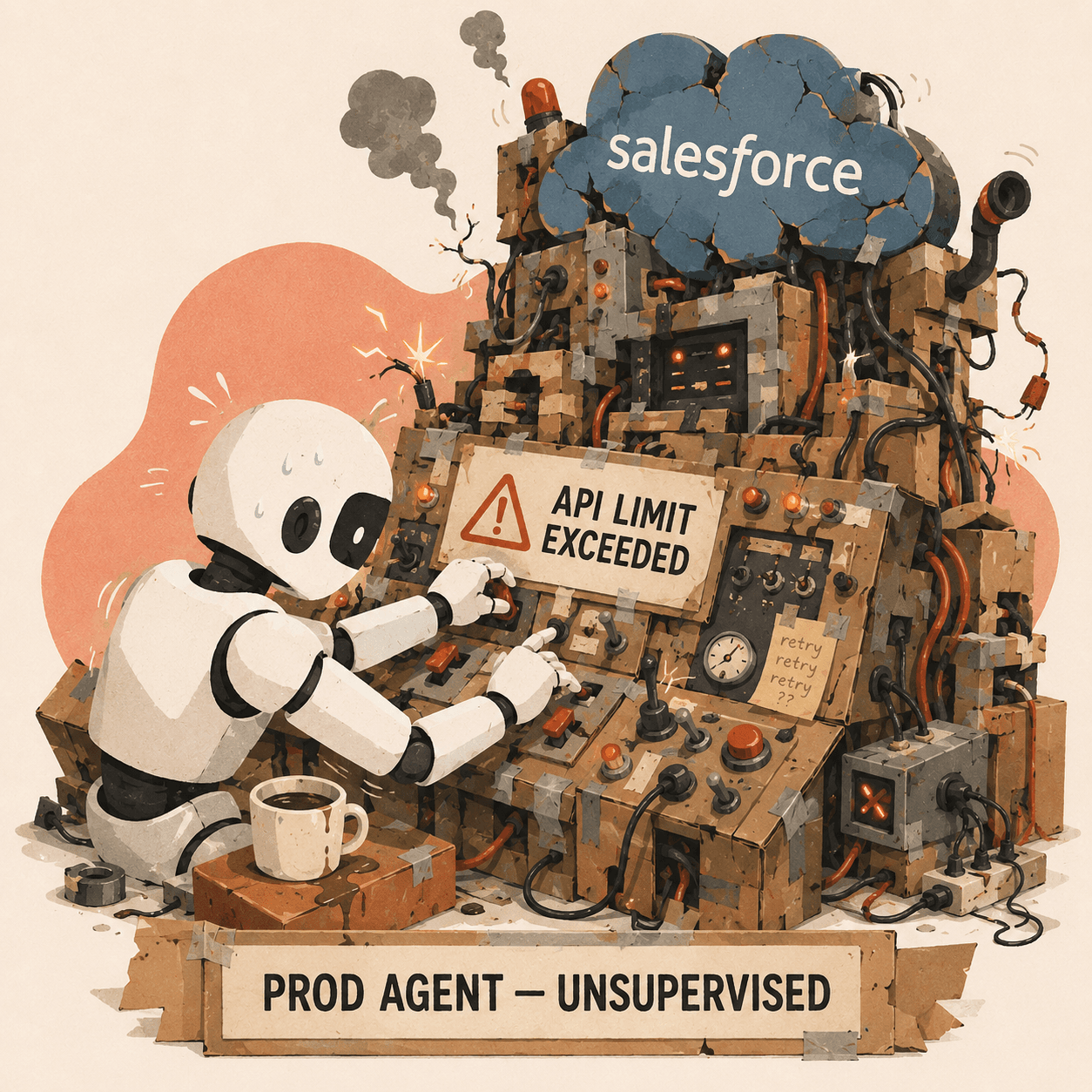
It changes the entire evaluation, because the question is no longer “can this partner configure Salesforce” — it’s “can this partner make my org safe for an AI agent to act inside.” Agentforce and AI agents don’t fail because the AI is weak. They fail because the underlying data is inconsistent, the permission model is loose, and the automation logic is undocumented spaghetti nobody trusts enough to let an autonomous process touch.
A partner solving last year’s problem will configure features, close the project, and leave you with a system that works for humans clicking through it carefully. A partner solving this year’s problem builds clean data architecture, sound governance, and the right guardrails so that when you turn on an agent, it can act — update records, trigger workflows, surface answers — without corrupting the system of record or exposing something it shouldn’t.
This is also where coexistence matters more than ever. Salesforce isn’t going anywhere as your system of record — the winning move in 2026 isn’t replacing it, it’s making it trustworthy enough that AI can finally act on top of it. Green Irony builds this way because we run our own company on the same principle: Notion and AI-native tools for how we operate day to day, Salesforce as the system of record underneath it all. We use what we sell. If you want to see what agent-ready architecture looks like in practice, start with our Salesforce consulting work — it’s built around this exact standard.
Frequently asked questions
What’s the difference between a Salesforce implementation partner and a Salesforce reseller?
A reseller sells you licenses. An implementation partner architects, builds, integrates, and supports the system those licenses run on. You need both roles covered, but they are not the same relationship, and a good implementation partner should never be incentivized primarily by license count.
How much does a Salesforce implementation partner cost?
It varies widely by scope, but fixed-price engagements are the more reliable model for budgeting — they force the partner to own the estimate instead of passing overage risk to you. Be skeptical of any quote that seems dramatically below market; it usually means junior staffing, offshore labor, or scope that will expand once you’re locked in.
Do I need a partner with MuleSoft experience if I’m only implementing Salesforce?
If Salesforce needs to talk to any other system — an ERP, a support platform, a billing tool — yes. Integration is where the majority of long-term technical debt in a Salesforce org actually originates, and a partner without real middleware experience will patch around that problem instead of solving it.