
Anthropic shipped a connector kit. The more important move is the one that comes next.
Anthropic shipped Claude for Small Business this week. The press coverage is mostly framing it as “AI productivity for SMBs” — Claude with connectors to Quickbooks, HubSpot, Slack, Microsoft 365. That framing is accurate, and it misses what’s actually significant.
The connector kit isn’t the news. The news is the question it forces every executive to answer: what does my executive team do when each leader has their own AI agent?
Most AI strategy I see in the field still asks the wrong question. CFOs ask “how do we make finance more efficient with AI.” CMOs ask “how do we make marketing more efficient with AI.” HR asks “how do we make hiring more efficient with AI.” Each function searches for its own productivity story.
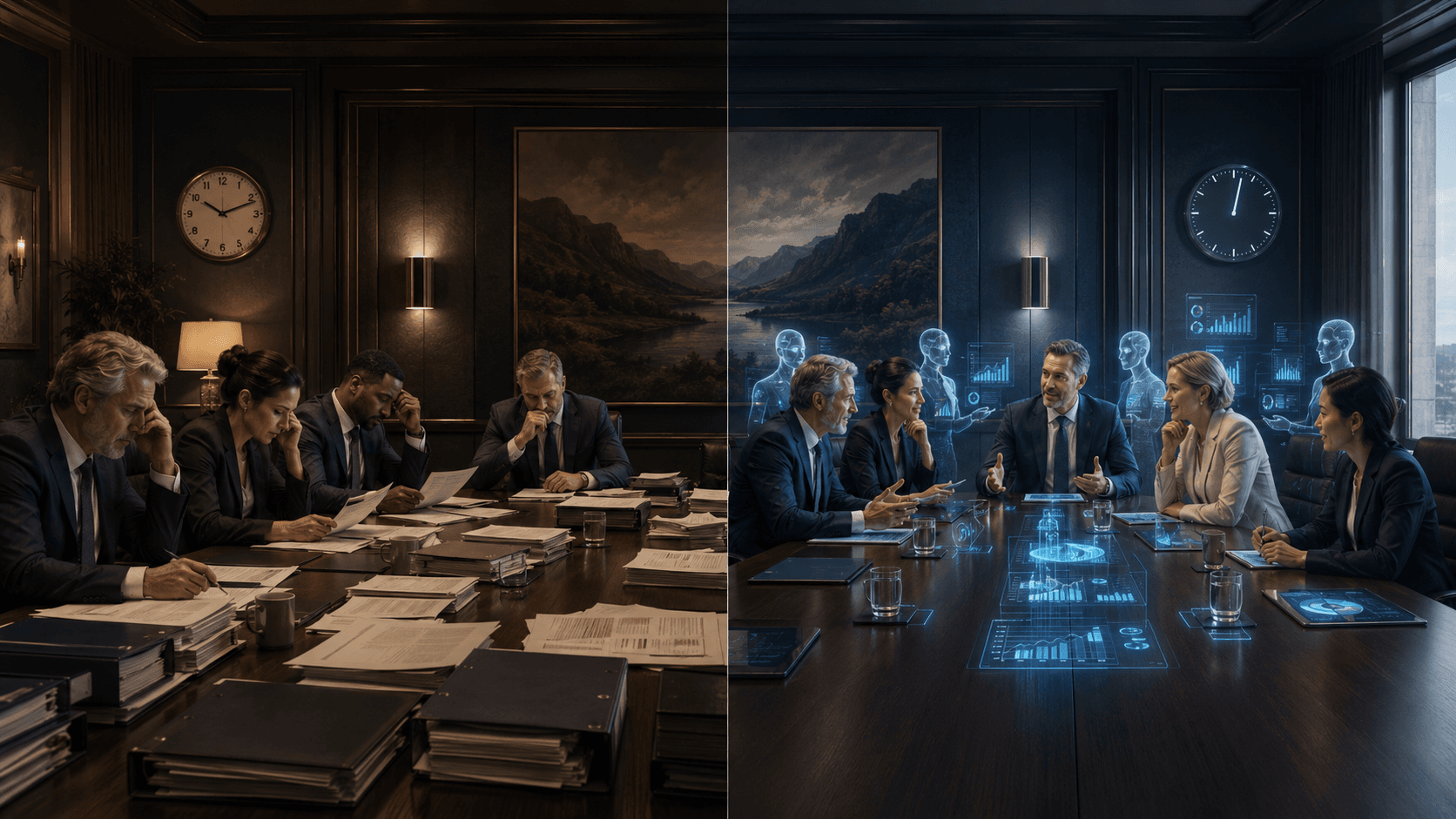
That’s the version of AI strategy that produces marginal results. The version that produces compounding results imagines a different operating model entirely: every executive has their own AI agent doing the analytical lift, and the collaboration between executives runs at a velocity it never did before.
Picture a CRO and a CMO sitting down to decide a campaign pivot, a new ICP, a pricing test. Pre-AI, that decision needs three weeks of analyst work upstream, two follow-up meetings to align, and a board memo two months later to confirm. Post-AI — the version where each leader has their own agent doing the prep, the research, the option-modeling — that decision happens in a single working session. The CRO brings their pipeline reality, surfaced by their agent. The CMO brings their audience analytics and campaign performance, surfaced by their agent. The conversation is denser, the options are sharper, the decision propagates back into execution through the same agents that prepped it.
That’s not “AI made marketing faster.” That’s marketing and revenue operating as a single decision system, with two executive humans at the helm and two AI agents doing the analytical lift.
We’ve been running this way at Green Irony. Strategic decisions that used to take three weeks of analyst cycles now land in working sessions. Cross-functional moves that used to die in handoffs happen in shared context. Our OPEX is down more than 75% as a result. That’s the headline finance reads. The more important story is what these functions now produce together that they couldn’t produce apart.
The executive layer doesn’t shrink. It levels up. CMOs still own marketing. CROs still own revenue. CFOs still own finance. What changes is what happens between them — the speed of cross-functional decisions, the depth of context each leader brings, the cadence at which strategic moves get made.
Claude for Small Business is the entry point. It puts AI inside the tools small businesses already use. That’s a useful starting move.
The harder question — and the more important one — is what happens when every executive has their own AI agent. Which strategic decisions in your business get faster? Which cross-functional conversations get denser? Which silos exist because the technology required them, not because the business required them?
Most companies haven’t operationalized this yet. The ones that do will compound while the others optimize.