
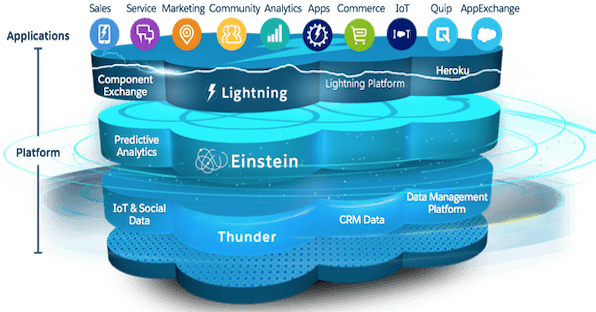
A while back, we made the claim that Salesforce is not a CRM. In the years since, I’ve kept running into the same misconception in the field. “Salesforce? That’s just a CRM, right?” or “Isn’t that just for sales forecasting and workflow automation?” come up constantly when our team works with customers to get real value out of the platform.
The short answer is still no. Salesforce is a best-in-class Platform-as-a-Service (PaaS) that accelerates development and lowers maintenance for any business-user-centric set of interfaces and workflows. And with MuleSoft, it extends to every back-end integration needed to supply and receive data for those scenarios — plus nearly any data or integration use case you can imagine.
To see why these two platforms are so powerful, let’s look at full-stack development, how many technologies it usually involves, and the role these platforms play in simplifying it.
Full-Stack Developer Unicorns
“Full-stack developer” is a common term in tech. These developers — relative unicorns of their craft — can build back-end services (retrieving and modifying data, integrating systems, codifying business logic) and the user interfaces on top. They’re considered unicorns because of the sheer number of technologies you have to master to deliver functionality from the interface all the way down to the database. A typical build involves, at minimum:
- HTML to represent the page elements of the user interface.
- CSS to add style, color, and structure to the page.
- A JavaScript framework (React, Vue, Angular) to render the page dynamically and react to user inputs like clicks and taps.
- Numerous JavaScript add-ons for basic UI functionality — responsive rendering on mobile, common elements like picklists, analytics integrations, social interactions, and so on. A typical site carries dozens of add-ons that all need maintaining.
- A database to serve as the source of truth for the records the UI needs.
- Programmatic middleware like Java, .NET, or Node.js to expose services the interface can call.
- Dozens of ancillary components for exposing, securing, and governing those web services, handling OAuth handshakes for social logins, communicating with other systems, and reading, writing, and modifying data — all stacked on top of the middleware.
The number of systems and components in play means building this way is time-consuming, and the maintenance cost to keep the lights on is significant.
How Salesforce Simplifies Full-Stack Development
To our team, the real power is two PaaS clouds working together — MuleSoft’s Anypoint Platform and the Salesforce Platform — that modernize and accelerate full-stack development. Together they let you do all of the work above and compress the development lifecycle top to bottom, eliminating the need to stitch together so many separate pieces of software.
The “how” is beyond the scope of one post, but the high-level benefits:
- Most “table stakes” functionality — data modeling, integration services, login and security, common workflows, mobile responsiveness, cross-component communication — is baked into the Salesforce Platform.
- Many high-level business workflows (sales, quoting, customer service, SLA enforcement, customer engagement, field service, analytics, and more) ship as licensable, customizable applications. Think of these as bolt-on value to your business.
- MuleSoft provides built-in connectors to the systems you need to integrate with — ERPs, data warehouses, SaaS platforms, mainframes, and more.
- A properly designed MuleSoft application network grows in value as more systems connect — future integrations get simpler as the network grows, instead of complexity rising with every new connection.
Combining the two eliminates dozens of software solutions and add-ons that would otherwise need to be maintained, updated, and managed by your IT team. Savvy CIOs can replace them with two PaaS platforms and shed a lot of the headaches that come from managing so many moving parts. It’s easy to see what Marc Benioff envisioned when he paid a 22x revenue multiple to bring MuleSoft into the Salesforce family.
But what about the use cases? Aren’t I limited with low-code platforms?
Most of our team comes from product development, enterprise architecture, and custom software design. Name a platform and someone here has likely built on it or something close. When we first heard “low-code,” our minds went straight to a lack of flexibility. What we found instead is that these platforms don’t have the gaps we expected — they let the business dictate complexity and cost based on value and requirements. They give businesses the power to decide whether a piece of functionality warrants a custom experience or whether an out-of-the-box one will do at a fraction of the implementation and maintenance cost.
Using these platforms, we’ve delivered use cases that are decidedly not CRM:
- An agent-facing portal for over 100,000 life insurance agents to manage policies, define relationships between prospects, and write new policies.
- Integration with risk-analysis data that gives loan officers a 360-degree view of how each commercial loan is progressing through underwriting.
- Cradle-to-grave workflow management for a large, global team of field-service workers who repair and maintain high-end medical devices for universities and research organizations.
- Onboarding of independent agencies for property-and-casualty insurance, cutting onboarding time and eliminating data-entry errors.
- An integrated application network that lets dozens of third-party services used to build a homeowner’s insurance quote be swapped without impacting other systems like the policy platform.
- And for ourselves: everything from revenue reporting and forecasting (yes, CRM functions) to everything after a services deal closes — contract generation, resource assignment, project health, profitability, and project governance.
Where This Goes Next
The simplest way to think of Salesforce is as a platform built to simplify and accelerate any business-user-facing experience — with MuleSoft handling the back-end complexity behind those experiences with ease. That was true when we first wrote this, and it’s the reason the platform is now the natural home for AI agents. Agentforce doesn’t change the thesis; it proves it. Agents act through the same data model, automation, and integrations that made this a platform in the first place — which is exactly why the companies with that foundation already in place are the ones putting AI into production.
We’re passionate about these platforms and what they do for businesses that use them well. Talk to us about getting the maximum impact from them.